
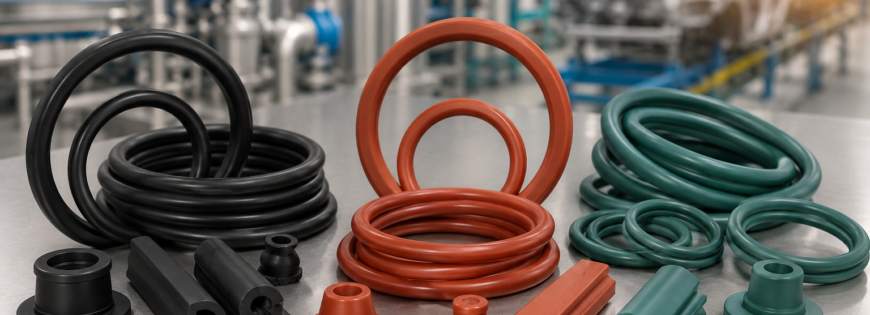
EPDM vs Silicone vs Nitrile — Choosing the Right Rubber Seal for Your Industry
Picking the wrong rubber compound for an industrial seal doesn’t just mean a slightly shorter service life — it can mean chemical degradation, seal failure, and unplanned downtime. EPDM, Silicone, and Nitrile are the three most commonly specified elastomers for industrial sealing, and each performs very differently depending on your operating environment. Here’s how to choose correctly.
EPDM (Ethylene Propylene Diene Monomer)
EPDM is the go-to choice when your application involves water, steam, or outdoor weather exposure. It has excellent resistance to ozone, UV, and aging, which makes it ideal for outdoor equipment, HVAC systems, and water-based processing environments. Its operating range typically spans -40°C to 150°C.
Best for: Water treatment equipment, HVAC gaskets, outdoor enclosures, steam systems.
Avoid if: Your application involves petroleum-based oils or fuels — EPDM degrades rapidly on contact with hydrocarbons.
Silicone
Silicone’s biggest strength is temperature range — it remains flexible from as low as -60°C up to 200°C+ (higher for specialty grades), making it the standard choice for extreme-temperature applications. It also offers strong resistance to UV, ozone, and weathering, and is widely used where food-grade or medical-grade compliance is required due to its low toxicity and inertness.
Best for: High-temperature equipment seals, food processing machinery, medical device components, electrical insulation.
Avoid if: You need strong mechanical/tear resistance or fuel and solvent resistance — silicone is comparatively weak here.
Nitrile (NBR)
Nitrile is the workhorse compound for oil, fuel, and hydraulic fluid exposure. Its resistance to petroleum-based products makes it standard in automotive, hydraulic, and general industrial machinery applications. It has decent abrasion and tear resistance but a narrower temperature range than EPDM or Silicone (roughly -30°C to 100°C) and poor resistance to ozone and weathering — so it degrades faster outdoors.
Best for: Hydraulic systems, fuel handling equipment, automotive components, general machinery seals exposed to oils and greases.
Avoid if: The application is outdoors or exposed to ozone/UV for extended periods without protection.
A Quick Decision Framework
Ask three questions before specifying a compound:
1. What’s the primary substance the seal will contact?
Water/steam → EPDM. Oil/fuel → Nitrile. Extreme heat or food-grade requirement → Silicone.
Water/steam → EPDM. Oil/fuel → Nitrile. Extreme heat or food-grade requirement → Silicone.
2. What’s the temperature range?
Below -40°C or above 150°C consistently → Silicone. Standard industrial range → EPDM or Nitrile depending on chemical exposure.
Below -40°C or above 150°C consistently → Silicone. Standard industrial range → EPDM or Nitrile depending on chemical exposure.
3. Is it exposed to sunlight or outdoor weathering?
EPDM or Silicone. Nitrile will crack and perish faster outdoors without added stabilizers.
Why Off-the-Shelf Often Isn’t Enough
Standard compound seals work for standard conditions — but many industrial applications involve a mix of exposure factors (heat plus chemical contact, or outdoor plus oil exposure) that a generic seal isn’t formulated for. This is where custom-compounded rubber sealing solutions, built to your specific operating conditions and dimensional requirements, outperform catalog parts. Getting the compound wrong is one of the most common — and most preventable — causes of premature seal failure in industrial equipment.
If you’re unsure which compound fits your application, share your operating temperature, chemical exposure, and environment details with a manufacturer who can recommend and prototype the right seal before committing to a full production run.